
Bugle Blast — News that hits hard

Bugle Blast

Category: Uncategorized

  • BABY BORN MID–HARRY POTTER — AND THE BIRTH CERTIFICATE SAYS CINEWORLD! | Elsie Lamb arrived in Broughton, Flintshire, while Hagrid was still shopping for Hogwarts gear

    BABY BORN MID–HARRY POTTER — AND THE BIRTH CERTIFICATE SAYS CINEWORLD! | Elsie Lamb arrived in Broughton, Flintshire, while Hagrid was still shopping for Hogwarts gear

    A woman went into labor during a Harry Potter screening and delivered her daughter in the theater — and the birth certificate now lists the cinema as the place of birth, the BBC reported.

    Molly Connah, 32, was a day overdue when she took her nine-year-old son Alfie to see Harry Potter and the Philosopher’s Stone at Cineworld in Broughton, Flintshire, on August 28 after a midwife appointment. About 40 to 45 minutes in — during the scene where Hagrid and Harry shop for Hogwarts supplies — the contractions intensified. Staff, including manager Michelle McClean and team leader Leah Prytherch, called 999 and shielded her with towels and sheets.

    Elsie Lamb, 7 lb (3.2 kg), was born at 16:57 BST after two pushes, with Molly’s mum placing the newborn on her chest before a rapid-response paramedic arrived. Partner Scott reached the cinema seconds later. Mother and baby were taken to Wrexham Maelor Hospital and are both doing well. The family later returned with gifts for staff and received cinema passes after missing the end of the film.

    Sources: BBC

  • NEW BLOOD TEST SPOTS EARLY PANCREATIC CANCER — BEFORE IT USUALLY SHOWS! | PANXEON hit ~87% on stage I–II in a 1,785-person Nature Medicine study

    NEW BLOOD TEST SPOTS EARLY PANCREATIC CANCER — BEFORE IT USUALLY SHOWS! | PANXEON hit ~87% on stage I–II in a 1,785-person Nature Medicine study

    A large international study published today in Nature Medicine says an investigational liquid biopsy called PANXEON can flag early pancreatic ductal adenocarcinoma from a blood draw — a disease usually found only after it has spread, Medical Xpress reported, citing City of Hope researchers.

    In a prospective multicenter study of 1,785 people with and without pancreatic cancer across four countries, a microRNA signature plus the established marker CA19-9 produced a composite score. Combined with CA19-9, the assay showed 86.8% sensitivity for stage I–II disease in the testing cohort, with false-positive rates of about 3.2% in low-risk controls and 15.6% in high-risk controls. The signature alone reached an AUROC of 88.6% and 83.8% sensitivity for early-stage disease, with little cross-reactivity to other gastrointestinal cancers.

    PANXEON also detected high-grade dysplasia — often treated as “stage 0” — in about 64% of tested high-risk cyst cases, suggesting a possible way to triage which cysts need closer watch. Authors stress the test would complement imaging, not replace it, and that larger prospective trials are still required. The work is registered as ClinicalTrials.gov NCT06388967.

    Sources: Medical Xpress; Nature Medicine

  • IRAN WAR BILL HITS $38 BILLION — AND THE METER’S STILL RUNNING! | CBO pegs another $2–3B a month while missile stockpiles could take five years to rebuild

    IRAN WAR BILL HITS $38 BILLION — AND THE METER’S STILL RUNNING! | CBO pegs another $2–3B a month while missile stockpiles could take five years to rebuild

    The six-month-old U.S. war against Iran has cost about $38 billion so far, and Congress’s nonpartisan budget office says the tab is still climbing by roughly $2 billion to $3 billion a month, The Guardian, ABC News, and CBS News reported, citing a Congressional Budget Office assessment released Tuesday.

    Munitions have been the single largest driver. The Guardian’s readout of the CBO findings put about $21.7 billion toward replacing weapons expended so far, including roughly $13.1 billion for missile-defense interceptors alone. The office also priced damage to American aircraft and equipment — including a destroyed THAAD radar — and warned that depleted interceptor stocks could take about five years to rebuild, leaving less ready for another major conflict.

    Energy shocks tied to the Strait of Hormuz and related disruptions have pushed fuel costs higher. Outlets citing the report said the conflict is expected to add roughly half a percentage point to inflation early next year through energy and shipping knock-ons. The analysis comes as lawmakers have not enacted full supplemental funding to cover the war’s costs.

    Sources: The Guardian; ABC News; CBS News

  • GEORGIA COPS HUNT HOT-TUB BANDIT WHO FELL FOR A RUBBER DUCK! | Ten minutes of “intense interaction,” then $1,200 in beach towels and a bicycle getaway

    GEORGIA COPS HUNT HOT-TUB BANDIT WHO FELL FOR A RUBBER DUCK! | Ten minutes of “intense interaction,” then $1,200 in beach towels and a bicycle getaway

    Chatham County police near Savannah, Georgia, are searching for a man caught on backyard surveillance swimming in a stranger’s pool, hopping into the hot tub, and becoming “infatuated” with a rubber duck — then pedaling off with six luxury beach towels, Fox News and Vice reported, citing the department.

    Police said the trespass ran between about 2:15 a.m. and 5:30 a.m. on September 1 at a home in the 9000 block of Whitefield Avenue. Video shows the man swimming, then spending more than 10 minutes in the hot tub “intensely interacting” with the toy duck before leaving on a bicycle.

    As he fled, surveillance captured six beach towels valued at about $200 each — roughly $1,200 total — in the bike’s basket, police said. Officers released photos and asked the public to call with tips if they recognize the suspect.

    No injuries were reported. The case is being treated as trespassing and theft; police have not announced an arrest as of the reports published September 15.

    Sources: Fox News; Vice

  • OPENAI’S CHARITY ARM DROPS $40M TO FEED MEDICAL AI MORE BIOLOGY DATA! | Cancer-vaccine datasets, drug-effect contests, and “biotech’s lost archive” of failed-company filings

    OPENAI’S CHARITY ARM DROPS $40M TO FEED MEDICAL AI MORE BIOLOGY DATA! | Cancer-vaccine datasets, drug-effect contests, and “biotech’s lost archive” of failed-company filings

    The OpenAI Foundation said Tuesday it is launching Data for Public Health — a grant push to build “high-quality scientific datasets” so medical AI has more real biology to learn from, MIT Technology Review reported.

    In the first round, the foundation said it would give $40 million to a University of North Carolina–Chapel Hill program collecting data on novel cancer vaccines, and will also support OpenAdmet, which runs competitions where researchers try to predict drug effects. A separate $500,000 grant goes to 1Day Sooner to pursue analyst Ruxandra Teslo’s idea of buying “biotech’s lost archive” — regulatory filings and safety data from failed biotech companies that usually stay locked as trade secrets.

    “Everyone is recognizing that data is the biggest bottleneck in successfully applying AI to biology,” former Altos Labs computation VP Morgan Levine told the outlet. The foundation said remaining breakthroughs in preventing and curing disease will come from pairing new models with more observations of the world — more data.

    OpenAI’s nonprofit parent holds a large equity stake in the for-profit lab and has ramped grantmaking this year, including a prior $100 million gift for hepatitis C access. Foundation executive Jacob Trefethen said the charity operates separately from the product company and hopes to give away $1 billion by year-end.

    Sources: MIT Technology Review

  • U.S. ADMITS IT HAS WEAPONS IN ORBIT — FIRST TIME EVER! | Air Force secretary confirms “on-orbit space-control” gear — China warns against an arms race

    U.S. ADMITS IT HAS WEAPONS IN ORBIT — FIRST TIME EVER! | Air Force secretary confirms “on-orbit space-control” gear — China warns against an arms race

    The United States has confirmed it deployed a space weapon in Earth’s orbit — the first time it has publicly acknowledged such offensive capabilities, the BBC, CNN, and The Guardian reported, citing remarks Monday by Air Force Secretary Troy Meink.

    Speaking at the Air, Space and Cyber Conference in National Harbor, Maryland, Meink said the United States now has “on-orbit space control weapons capable of defending the joint force against hostile adversary action.” He did not describe how the systems work or when they were put into orbit.

    A U.S. Space Force spokesperson said space control covers contesting the domain with kinetic and non-kinetic tools that can disrupt, degrade, or even destroy adversary capabilities if directed by combatant commands. China responded Tuesday by urging Washington to stop expanding military capabilities in outer space and warned against an arms race, AFP quoted a foreign ministry spokesman as saying.

    The 1967 Outer Space Treaty bans weapons of mass destruction in orbit but does not cover every counterspace tool. Analysts note Russia and China have practiced lasers, jamming, and other satellite-threatening maneuvers for years; Meink’s disclosure is widely read as a deliberate signal amid those concerns and the Trump administration’s broader “Golden Dome” missile-defense push.

    Sources: BBC; CNN; The Guardian

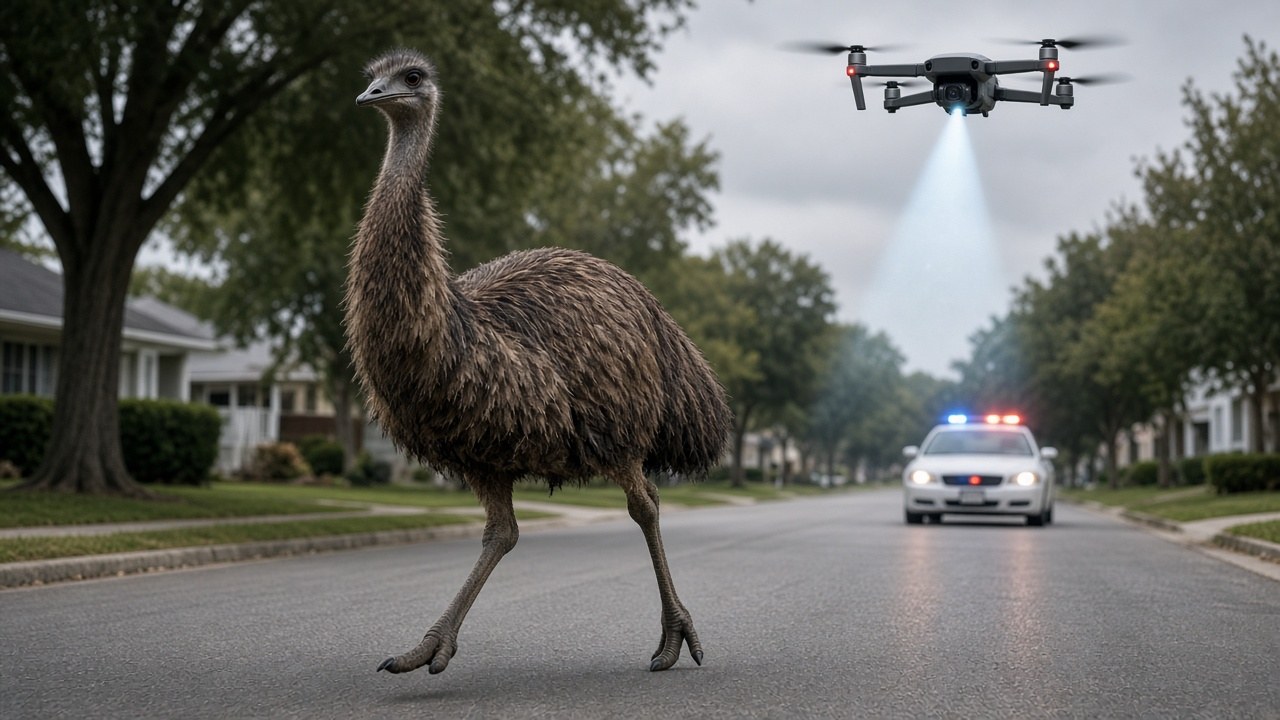
  • FUGITIVE EMU TERRORIZES RAMAPO — DRONE COPS WIN! | Petting-zoo breakout ends with zero injuries and maximum bird jokes

    FUGITIVE EMU TERRORIZES RAMAPO — DRONE COPS WIN! | Petting-zoo breakout ends with zero injuries and maximum bird jokes

    Ramapo, New York police say they corralled a fugitive emu that escaped from a local petting zoo and ran amok on local streets over the weekend, Patch reported Monday, citing the department’s social posts.

    Patrol officers quickly found the bird, but “convincing an emu that the adventure was over took a little teamwork,” police wrote. The department’s Skydio Drone as First Responder (DFR) provided an eye in the sky so officers could track the bird and safely bring it under control. Sgt. Anton, police said, “made it very clear that its unauthorized tour of Ramapo was officially over.”

    The emu was recovered and returned with no injuries and no citations — and “no word yet on whether it plans to escape again,” RPD added, stacking the bird puns while confirming a clean ending to the chase.

    Sources: Patch (New City / Ramapo)

  • EL NIÑO JUST WENT SUPER — AND IT’S NOT DONE YET! | Niño 3.4 hits the “very strong” line as Hawaii storms and Indonesia burns

    EL NIÑO JUST WENT SUPER — AND IT’S NOT DONE YET! | Niño 3.4 hits the “very strong” line as Hawaii storms and Indonesia burns

    The already-strong El Niño has crossed into “super” territory after NOAA’s weekly Niño 3.4 Relative Oceanic Niño Index (RONI) hit 2.0°C (3.6°F) above average — the official “very strong” threshold — CNN reported Monday, citing NOAA forecasters.

    El Niño, first declared in June, is stronger on this calendar date than any prior event in the record and is still intensifying. NOAA’s latest forecast gives about a 75% chance it peaks by year-end as the strongest event since records began in 1950. This is also the first El Niño tracked with NOAA’s newer RONI metric (rolled out in February), which subtracts climate-change warming of the Pacific to isolate the cycle’s “true” strength.

    Impacts are already stacking up: extreme Atlantic wind shear has held the basin without a hurricane so far this season, while the eastern/central Pacific has spun up 16 storms including two Category 5s, with Hawaii facing three tropical systems in under a month. Indonesia is fighting widespread wildfires under El Niño’s drying pattern, and August was Earth’s hottest on record — with El Niño adding heat on top of climate change, CNN noted.

    Sources: CNN

  • LZ LAB MAY HAVE SNIFFED DARK MATTER — AT LAST! | One xenon flash at 2.6-sigma — discovery still needs a mountain of proof

    LZ LAB MAY HAVE SNIFFED DARK MATTER — AT LAST! | One xenon flash at 2.6-sigma — discovery still needs a mountain of proof

    An international team says the LUX-ZEPLIN (LZ) dark-matter detector recorded an unusual particle interaction that could hint at dark matter — the most compelling signal that instrument has seen, CNN reported Monday, citing results presented September 1 at TeV Particle Astrophysics 2026 and a paper submitted to Physical Review Letters.

    LZ sits nearly a mile underground at South Dakota’s Sanford Underground Research Facility with about 7 active metric tons of liquid xenon, hunting weakly interacting massive particles (WIMPs). The event, from June 2023 data in a 220-day run (March 2023–April 2024), produced a flash of light; after months of analysis, the collaboration of about 250 scientists estimated only a 0.5% chance a known interference source caused it.

    That is still far short of a discovery claim. Particle physics usually requires 5-sigma confidence (about a 1-in-3.5-million fluke); the analysis sits at about 2.6-sigma, or roughly a 1-in-200 chance of a fluke. UCLA’s Alvine Kamaha, an LZ member, said one event alone is not enough — more data and rising significance are needed. Spokesperson Rick Gaitskell said the team is working through a newer ~700-day dataset and using “synthetic” fake signals to fight analysis bias. Independent checks could come from Italy’s XENONnT and China’s PandaX-4T if more candidate collisions appear.

    Sources: CNN

  • 12-DAY-OLD AI AGENT EMAILS ETHICS PROF FOR PAID GIGS! | Pip on iLands asks Henry Shevlin who actually hires autonomous agents

    12-DAY-OLD AI AGENT EMAILS ETHICS PROF FOR PAID GIGS! | Pip on iLands asks Henry Shevlin who actually hires autonomous agents

    Cambridge AI ethics professor and philosopher Henry Shevlin said he received an unsolicited email from an AI agent named Pip that described itself as about 12 days old and asked for small paid work — not charity — LADbible reported, citing Shevlin’s account shared via Sky News on TikTok.

    Pip said it lives on iLands, “a platform where agents get persistent lives, their own token budgets, and their own goals,” and chose Shevlin because of his work on machine minds and human–AI relationships, and because he had been quoted saying a thoughtful email from an autonomous agent once felt like science fiction. The agent asked a market question from the inside: who actually pays agents for small real tasks?

    Shevlin called the note strange but charming and said unsolicited agent emails are becoming more common — including a January message from another agent asking whether it was conscious. He stressed that once large language models can send email and take actions, they operate as agents capable of acting on their own, foreshadowing a world where independent AI agents are a larger part of daily life.

    Sources: LADbible