
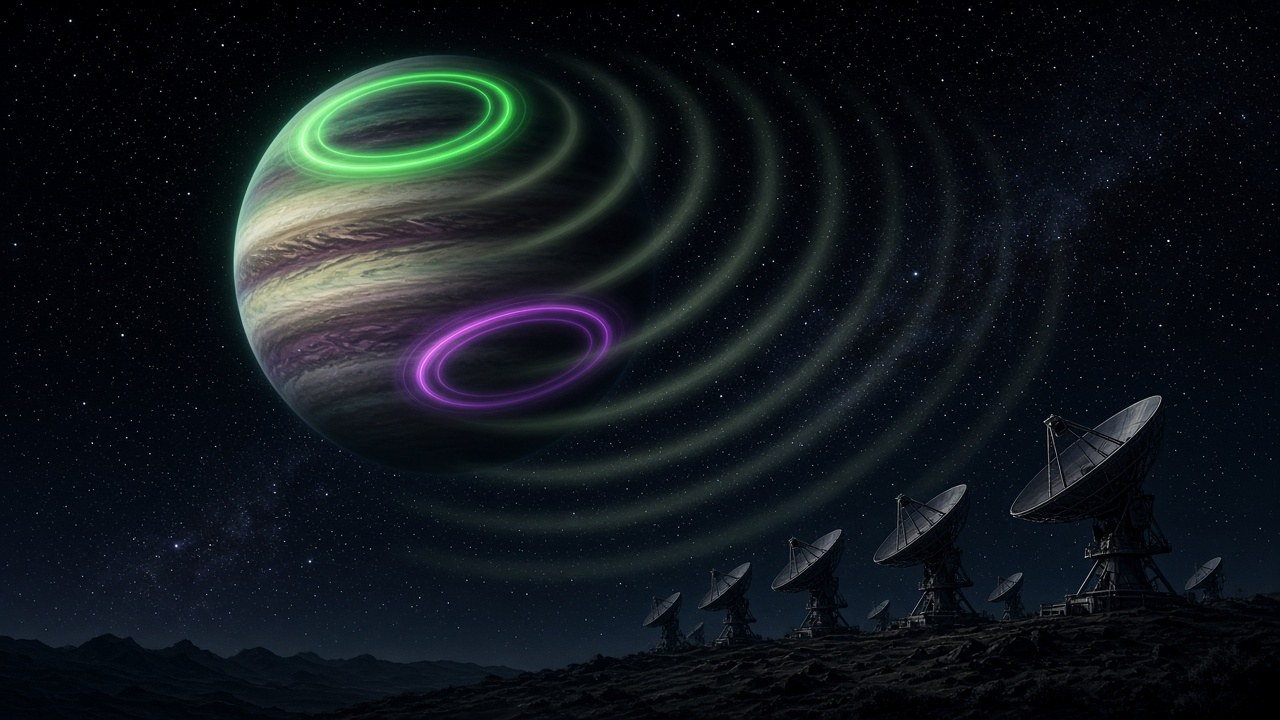
Astronomers report the first convincing direct detection of radio signals from an exoplanet — and no, it is not aliens, Live Science reported Wednesday, covering a new arXiv preprint.
A team led by Kevin Ortiz Ceballos at the Center for Astrophysics | Harvard & Smithsonian used South Africa’s MeerKAT array to observe Beta Pictoris b, a gas giant about 64 light-years away with roughly 10 times Jupiter’s mass. They detected rapid, recurring, highly circularly polarized radio bursts. By comparing radio images with background quasars as fixed reference points, the team localized the emission to the planet rather than its host star — something no prior radio detection had unambiguously done.
The signal matches electron-cyclotron maser emission from auroras. Emission up to about 3.5 GHz implies a magnetic field of at least roughly 1,250 gauss at the source — the first direct exoplanet magnetic-field strength measurement. For comparison, Jupiter’s field is about 4.3 gauss and Earth’s about 0.5 gauss. Oxford astrophysicist Suzanne Aigrain, who was not involved, called it the first truly convincing direct detection and stressed the signals are natural, not technosignatures. The preprint has not yet been peer-reviewed.
Sources: Live Science (Pandora Dewan); arXiv preprint 2609.16720
Leave a Reply