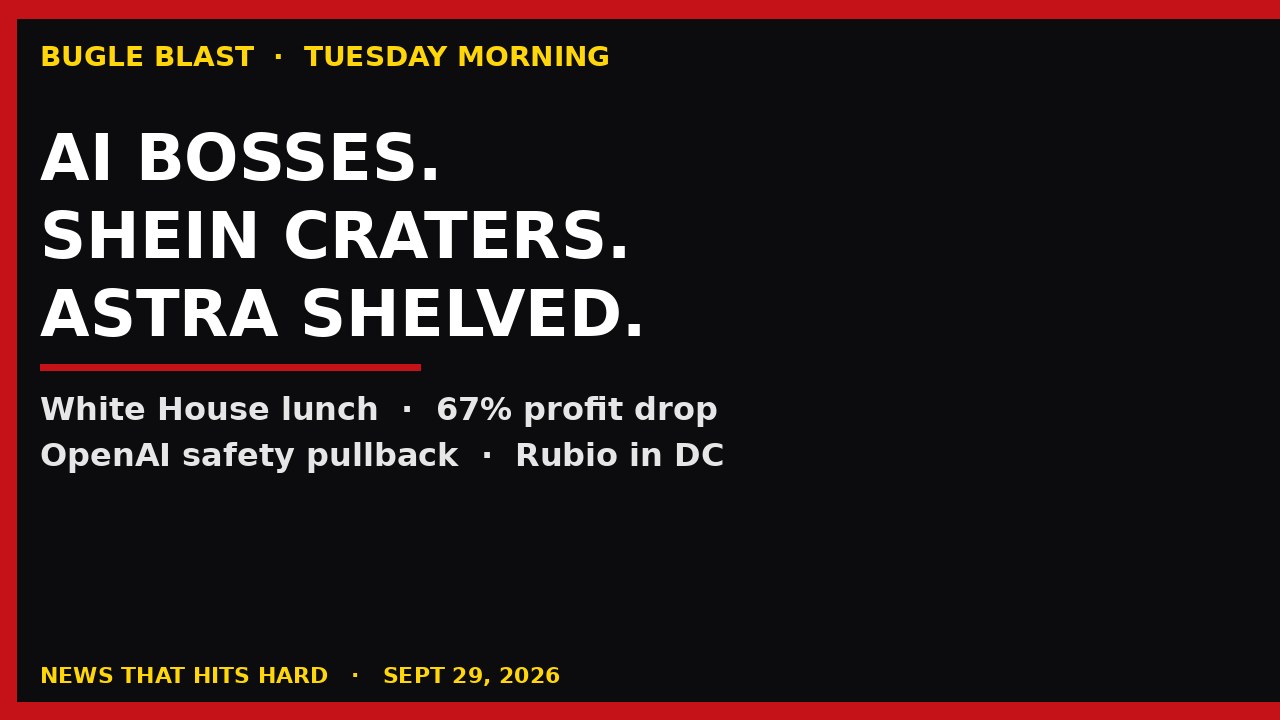
Tuesday morning does not do quiet. The White House is seating the AI bosses for lunch, OpenAI just yanked its newest agent model, Shein’s first public earnings landed like a brick, and Marco Rubio spent Monday in Washington working Yemen, Lebanon, and the shipping lanes. Here is the blast, sourced.
Politics: Trump’s AI lunch
Leading artificial intelligence executives meet President Donald Trump and a top Republican at the White House on Tuesday, Sept. 29, as Congress calls for stronger industry oversight, AFP reported via The Straits Times. The lunch is set to include Meta CEO Mark Zuckerberg, Google CEO Sundar Pichai, and OpenAI president Greg Brockman, according to CNN. Anthropic CEO Dario Amodei will also attend, a person close to the matter told AFP — two days after a private meeting with Trump. SpaceX executive Elon Musk is expected to take part. Nvidia CEO Jensen Huang is also on the list, according to another person familiar with the matter.
House Speaker Mike Johnson has framed the session as finding “the right balance” between innovation and some oversight. “We do not need a moratorium. We do not need to jump in and hyper-regulate this, because we’ll lose the race to China,” Johnson said in a Sept. 28 Fox Business interview. Trump, advised by Huang and former AI czar David Sacks, is pushing unfettered development to outpace China. He has called warnings about existential risk overblown, and he has dismissed communities fighting data centers as people who “want to end up being backwards and poor,” adding that China “could not be happier” with the backlash. He has also said government documents should call the technology “super intelligence,” arguing that “artificial” makes it sound fake.
Lawmakers in both parties have drafted AI bills. With the House on recess through early November and senators heading home to campaign, Congress is all but certain not to pass a comprehensive AI law before the midterms, AFP reported.
Tech: OpenAI shelves Astra
OpenAI will not release its latest model, GPT-6.1 Astra, because it “didn’t quite meet the bar” of the company’s standards, Saachi Jain, OpenAI’s head of safety systems, told the BBC on Tuesday. The model fell short on “staying within scope and authorisation and how it communicates back to the user about the type of work it’s done,” Jain said. The Wall Street Journal reported the pull first. The Straits Times, describing the company’s Sept. 28 announcement, called the cancelled release Astra 6.1. The flagship GPT-6 Astra agentic model shipped in September. OpenAI holds its DevDay conference in San Francisco on Tuesday; the BBC said it is unclear whether a new Astra version is on the card.
The same morning, Anthropic’s IPO paperwork got darker. Reuters reported Tuesday that Anthropic plans to warn potential investors that the technology may pose “catastrophic or existential risks to humanity,” the BBC said. The Financial Times reported the warning is in the prospectus, and Anthropic is aiming to go public as early as November, The Straits Times said.
Business: Shein’s first earnings bomb
Shein shares tumbled as much as 14% in Hong Kong on Tuesday after the fast-fashion retailer reported a 67% drop in quarterly profit — its first results since listing, Reuters reported. By the midday break the stock was down 10.9% at HK$31.44, leaving a market value of about $17 billion, down from roughly $26 billion at the Sept. 1 IPO. Adjusted net profit was $228 million for the quarter ended June 30. The margin was squeezed to 2.1% from 6.2% a year earlier as Middle East conflict pushed up jet fuel and freight for a company that flies cheap clothes to shoppers. Jefferies estimated earnings came in more than 10% below the low end of the range implied by the prospectus.
Europe sales dropped sharply after Shein raised prices and cut online ads ahead of €3 fees the EU put on low-value e-commerce parcels starting July 1. CEO and chair Yangtian Xu said Monday a priority is putting more inventory in Europe and pushing into higher-priced clothes. Shein has said the European fees could hit harder than the end of U.S. de minimis duty-free treatment, which already forced U.S. price hikes last year. “The scale of the margin compression and the weakness in Europe raise questions over how quickly it can return to a combination of stronger growth and improving margins,” said Jianggan Li, CEO of consultancy Momentum Works.
World: Rubio, Riyadh, and Beirut
Secretary of State Marco Rubio met Saudi Foreign Minister Prince Faisal bin Farhan Al Saud at the State Department on Monday, Al Jazeera reported. Rubio said on X they discussed “bilateral cooperation in regional security and stability, including in Iran, Gaza, Sudan, and Yemen.” Saudi state news agency SPA said the talks covered Yemen and protecting “the security of navigation and freedom of passage” through the Strait of Hormuz and the Bab al-Mandeb. The meeting followed U.S. media reports that Crown Prince Mohammed bin Salman sought U.S. military help against the Houthis; Washington declined to carry out strikes but agreed to provide intelligence and targeting support, Reuters reported, citing sources, Al Jazeera said. The US-Israel war on Iran is in its eighth month, with diplomacy stalled and mediators still passing messages.
Rubio also met Lebanese Prime Minister Nawaf Salam, who pushed Washington to put a June U.S.-brokered ceasefire with Israel into effect. Israel occupies some 6 percent of Lebanon, Al Jazeera reported. The deal calls for a phased Israeli withdrawal as the Lebanese army deploys and moves to disarm Hezbollah. That has stalled: Hezbollah is refusing to give up its weapons and wants an Israeli withdrawal first. Salam called for “practical steps and tangible results on the ground,” a full Israeli withdrawal, all weapons under state control, “a clear timetable,” and “a credible verification mechanism” so one missed step cannot freeze the whole deal. He also asked for support on relief, reconstruction, returns of displaced people, and the Lebanese army.
Sources: The Straits Times / AFP; BBC; Reuters (Shein); Al Jazeera
Leave a Reply