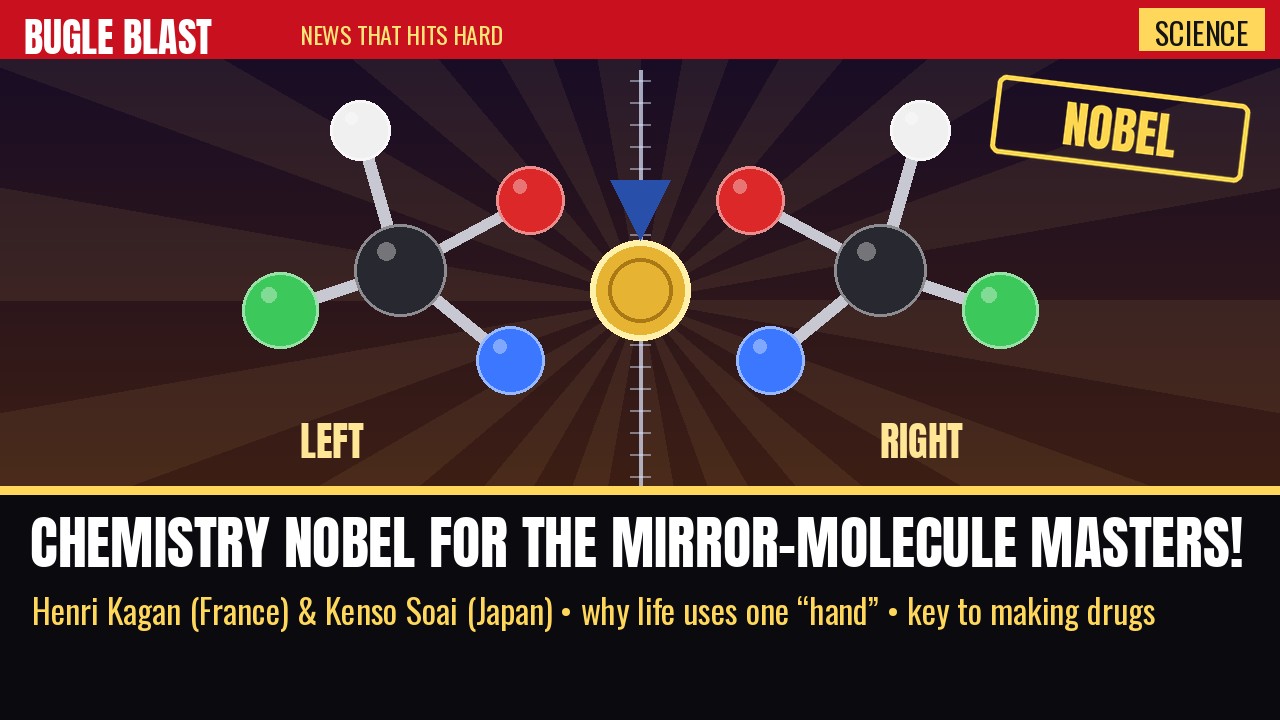
Look at your hands. That’s the prize. The 2026 Nobel Prize in Chemistry goes to Henri B. Kagan of Université Paris-Sud in France and Kenso Soai of Tokyo University of Science in Japan “for the discovery of non-linear effects and autocatalysis in asymmetric organic synthesis,” the Royal Swedish Academy of Sciences announced Wednesday.
The riddle: many molecules, like amino acids, come in two mirror-image versions — “chiral,” like left and right hands. Life uses only one. But lab reactions usually spit out a 50-50 mix, and in medicine that matters, because one version can fight disease while the other does nothing or even causes harm, BBC News explains.
Kagan took the first decisive step in 1986, finding a way to manipulate reactions to create a bigger excess of one mirror image than anyone thought possible. Soai went further: in 1995 he described the first reaction with the potential to be homochiral, and in 2003 he pulled it off — a reaction that formed only one of the two possible mirror images. “Other than life itself, no one had previously achieved this feat,” the academy says.
“Henri Kagan and Kenso Soai have provided a solution to a chemical mystery that is over a century old: how homochirality can emerge spontaneously. The chemical reactions they have developed are spectacular,” said Heiner Linke, chair of the Nobel Committee for Chemistry. Committee member Peter Somfai called it “probably the most fundamental question in life,” adding that something like it happened four billion years ago — “and now we have, for the first time, mimicked that in the lab.”
Soai, on the phone with the Nobel press conference: “This is one of the most exciting days of my life.” Kagan was born in 1930; Soai in 1950. They split 12 million Swedish kronor — about $1.25 million, per the BBC — and the academy says their work has been decisive for chemists designing reactions to make pharmaceuticals.
Sources: NobelPrize.org press release · BBC News
Leave a Reply