
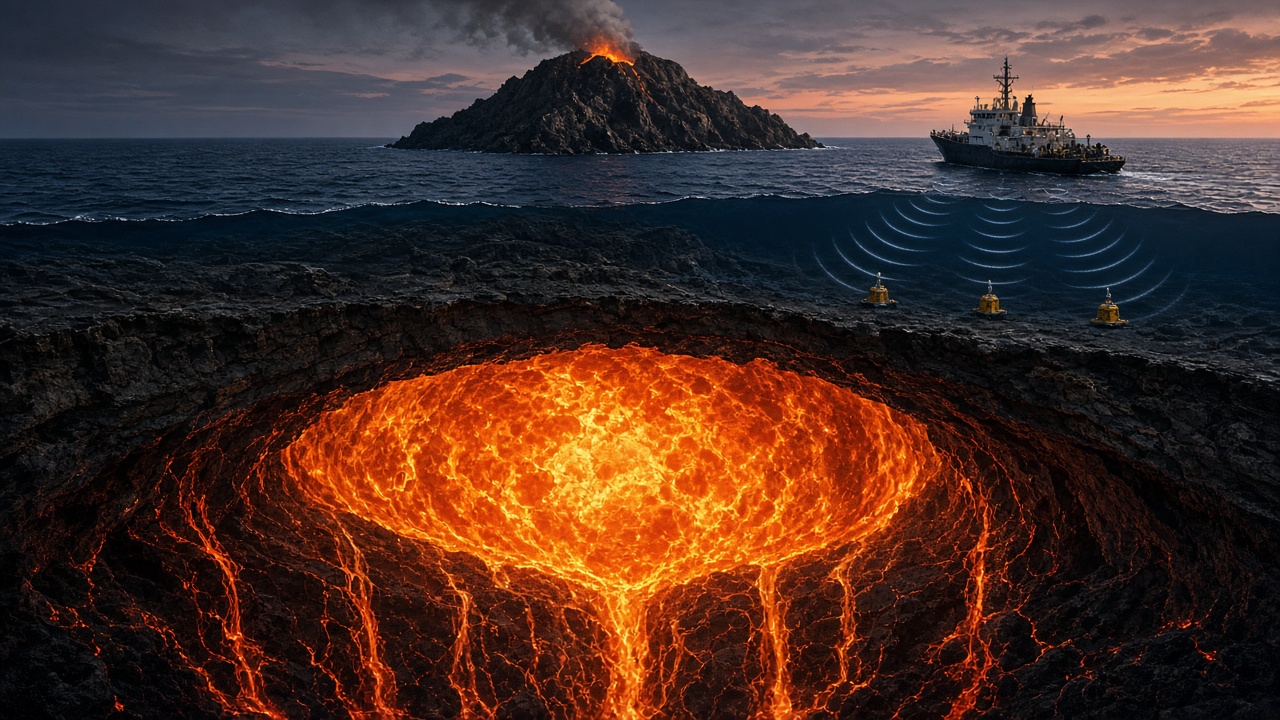
THE BEAST IS RELOADING! Deep beneath Japan’s mostly underwater Kikai caldera, a massive magma reservoir is filling back up, roughly 7,300 years after it produced the largest known volcanic eruption of the Holocene, the geological epoch we’re still living in, according to a Kobe University study reported by ScienceDaily.
How they found it: researchers from Kobe University and the Japan Agency for Marine-Earth Science and Technology (JAMSTEC) fired airgun arrays to send seismic pulses through the crust and listened with ocean-bottom seismometers. Waves travel differently through solid rock than through molten material, and the data showed a big region with a high proportion of magma sitting right under the site of the ancient eruption.
“Due to its extent and location it is clear that this is in fact the same magma reservoir as in the previous eruption,” said Kobe University geophysicist Nobukazu Seama.
Here’s the twist: it isn’t just leftovers. A new lava dome has been growing in the middle of the caldera for about 3,900 years, and its rock has a different chemical makeup from the giant eruption’s. That points to freshly injected magma from deeper in the crust or mantle. “This means that the magma that is now present in the magma reservoir under the lava dome is likely newly injected magma,” Seama said.
Before anyone panics: the researchers say this does not mean another catastrophic eruption is imminent. It shows how a reservoir can recharge over thousands of years, which scientists need to understand before they can judge where supervolcanoes are headed. Seama says the same re-injection model fits the big shallow magma reservoirs under Yellowstone and Indonesia’s Toba. The goal, he said, is “to become better able to monitor the crucial indicators of future giant eruptions.”
The study was published in Communications Earth & Environment.
Featured image: AI-generated editorial illustration by Bugle Blast.
Sources: ScienceDaily (Kobe University), Communications Earth & Environment
Leave a Reply