
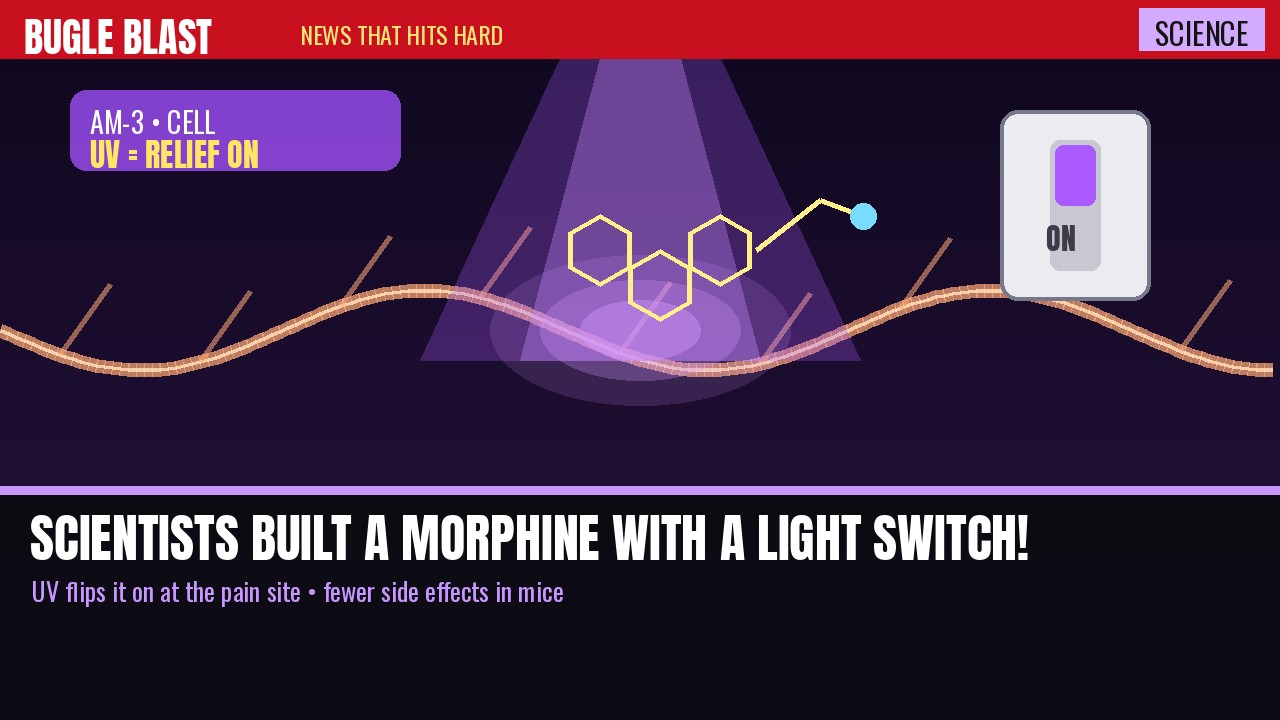
Opioids are the strongest painkillers we have, and they hit the whole body to get there: the brain, the gut, the breathing center. A team of chemists just gave morphine an on/off switch, and the switch is a flashlight.
In a study published Oct. 15 in Cell, researchers led by Weill Cornell Medicine and the University of Pennsylvania describe AM-3, a morphine-based compound that changes shape depending on the light that hits it. Under near-ultraviolet light, it strongly activates the mu-opioid receptor, the main target of opioid painkillers. Under blue light, it backs off. It can flip back and forth over and over.
The payoff: inject it, shine a brief burst of UV on the sore spot, and you get morphine-like relief just there. In mouse models, including bone cancer pain and visceral pain, the team saw reduced or no signs of tolerance, constipation and other side effects. AM-3 also has trouble getting into the brain, which helps keep addiction and breathing suppression in check.
“We think this is a significant breakthrough not just for pain management but also for the general strategy of photopharmacology,” said co-senior author Joshua Levitz of Weill Cornell. Penn chemist Dirk Trauner, the other senior author, said the goal is to make opioids safer “by controlling them with light in the periphery.” The trick borrows from the eye, where light flips the shape of retinal to trigger vision, C&EN reports.
The stakes: the Cornell team cites CDC data showing more than 40,000 Americans died last year from overdoses involving opioids.
The catch: UV light can damage eyes and skin, and this is still preclinical work in mice. The team is building successor molecules that switch with safe visible light, ideally red light that penetrates deep into tissue, and hopes to reach clinical trials eventually. “We have some exciting preliminary results already,” Trauner said.
Pain relief where you point it, and as little as possible everywhere else. It’s early, but it’s a real attack on what makes opioids dangerous.
Sources: Cornell Chronicle / Weill Cornell Medicine — Light-activated opioid painkiller may work without dangerous side effects · C&EN — A light-activated morphine derivative relieves pain in mice
Featured image: AI-generated editorial illustration by Bugle Blast.
Leave a Reply